
Flow map
Three flows run through Assay. Each step is tagged: Built exists and has a contract ID, transaction or live URL; Demo sprint exists as a demo or draft; T1/T2/T3 is planned for that tranche; After launch comes after mainnet.
The diagrams are the target design from the architecture.
The whole system
Section titled “The whole system”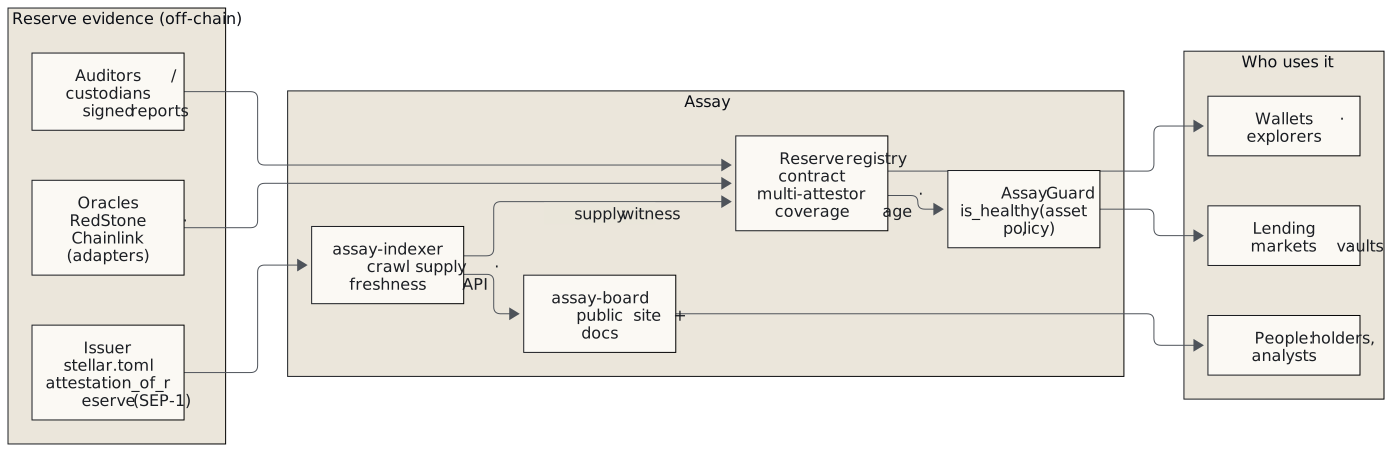
| Part | Status |
|---|---|
| Indexer census and board, on mainnet data | Built assay.wtf |
| Registry contract | Built testnet (IDs) |
| Guard contract | Built testnet |
| Reserve report format | Demo sprint draft SEP |
| Risk-context checks: issuer flags, redemption path, exit liquidity, collateral signatures | T1 |
| Public API v1, daily refresh, correction workflow | T1 |
Independent vs issuer attestors; guard reasons UNKNOWN_ASSET, NO_INDEPENDENT_ATTESTOR |
T2 |
| Indexer posting supply as witness on mainnet | T3 |
| Oracle adapters (RedStone, Chainlink) | After launch |
| SDK for wallets and explorers to read status | T2 |
1. Board check (no permission needed)
Section titled “1. Board check (no permission needed)”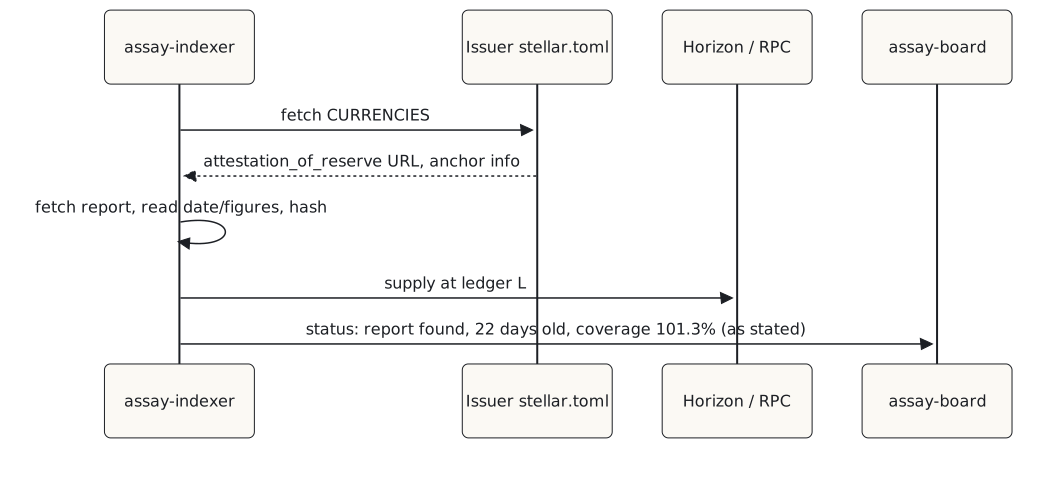
- The indexer lists Stellar mainnet assets and their issuers’ home domains. Built
- It reads each
stellar.tomland its SEP-1 currency fields. Built - It fetches the reserve link, records the HTTP result, type, size and SHA-256, and reads a date and figures when it can. Built
- The board publishes the snapshot, with sources, weekly. Built
- Issuers correct mistakes through a public log. Demo sprint
2. An attestor posts a report
Section titled “2. An attestor posts a report”- The attestor writes a
reserve-report-v0document and signs it with SEP-53. Built (sign-report) - It publishes the document and posts the figures, the document’s URL and
SHA-256 to the registry with
post_report. Built testnet - The registry checks the attestor is registered and signed the call, the unit, the dates and the order. Built testnet
- The
assay report sign/postCLI commands. T2 - Timelocked attestor changes; issuers claiming their asset via
stellar.toml. T2
The architecture’s diagram for this flow shows the target design, in which the registry also checks the report’s signature on chain.
3. The circuit breaker trips
Section titled “3. The circuit breaker trips”- A borrower asks a lending pool to borrow against an RWA. Built testnet demo pool
- The pool calls
is_healthy(asset, policy)on the guard. Built testnet - The guard reads
status_withfrom the registry and returns(false, reason)for the first rule that fails. Built testnet - The pool rejects the borrow and records the reason; nothing moves. Built (demo run)
- A scoped keeper for pools that can’t change their code. After launch
- Pilots with real protocols and attestors. T2
Architecture as a PDF
Section titled “Architecture as a PDF”The full architecture is available as a printable PDF: assay-architecture.pdf.