
How it works
Picture a weights-and-measures office in a market town. Inspectors check the scales, write the result in a public ledger, and a shopkeeper can look up any stall’s last inspection before trading with it. Assay has the same three jobs: check, record, and let others act on the record.
1. The board checks what issuers publish
Section titled “1. The board checks what issuers publish”Every week, Assay’s indexer reads Stellar’s main network and each issuer’s
stellar.toml file. For every asset that claims backing it records:
- whether the issuer links a reserve report,
- whether that link opened when it was checked,
- how old the report is, if the date can be read,
- what the report says, if a computer can read it.
The board at assay.wtf shows the result. Every figure links to its source, and every asset page has a link for the issuer to correct a mistake.
Coming in T1: a daily refresh, a public API, supply at a recorded ledger,
and the checks a lender asked for before accepting RWA collateral: issuer
controls (clawback, authorization flags, signer thresholds), the redemption
path, exit liquidity on the Stellar DEX and AMMs, and the validity windows of
collateral_address_signatures.
2. The registry records signed reports
Section titled “2. The registry records signed reports”Some issuers and auditors want their reports read by software. For them, Assay has a registry: a smart contract on Stellar.
- The asset’s administrator approves one or more attestors: firms that check reserves, such as auditors.
- Each attestor posts a report: reserves held, tokens owed, the date the figures are true for, and a fingerprint (a SHA-256 hash) of the full report document.
- A supply witness posts how many tokens actually exist, so a report can’t understate what’s owed.
Coming in T2: each attestor is recorded as independent (an auditor, custodian or oracle) or as the issuer, so you can see who vouches for an asset.
Anyone can read an asset’s status from the registry. It is worked out when you ask, from the reports that are still fresh, and it always takes the cautious view: the lowest coverage any attestor reported, and the larger of “tokens owed” and “tokens that exist”. The exact rules are in Status rules.
3. The guard answers one question
Section titled “3. The guard answers one question”A lending protocol doesn’t want a table of numbers in the middle of a loan. It wants a yes or no. The guard is a smart contract that reads the registry and answers:
Is this asset healthy under my rules?
The protocol sets its own rules (its policy): how much coverage is
enough, how old a report can be, how many attestors it wants. The guard
replies true or false, and when it’s false, the first rule that failed:
no report, stale, too few attestors, undercovered, attestors disagree, or
supply mismatch.
What happens next is up to the protocol. In the testnet demo, a small lending pool rejects the borrow and records the reason on chain. The guard itself never moves money.
4. A standard for the report itself
Section titled “4. A standard for the report itself”The fourth part is a draft Stellar standard (SEP) that turns the reserve
link in stellar.toml into a report a computer can read: reserves by type
and custodian, liabilities, the ledger, who attests and in what role,
fingerprints of the evidence, and a signature by a key listed in
stellar.toml. Plain PDF links keep working. See
Signed reserve reports.
How the pieces fit
Section titled “How the pieces fit”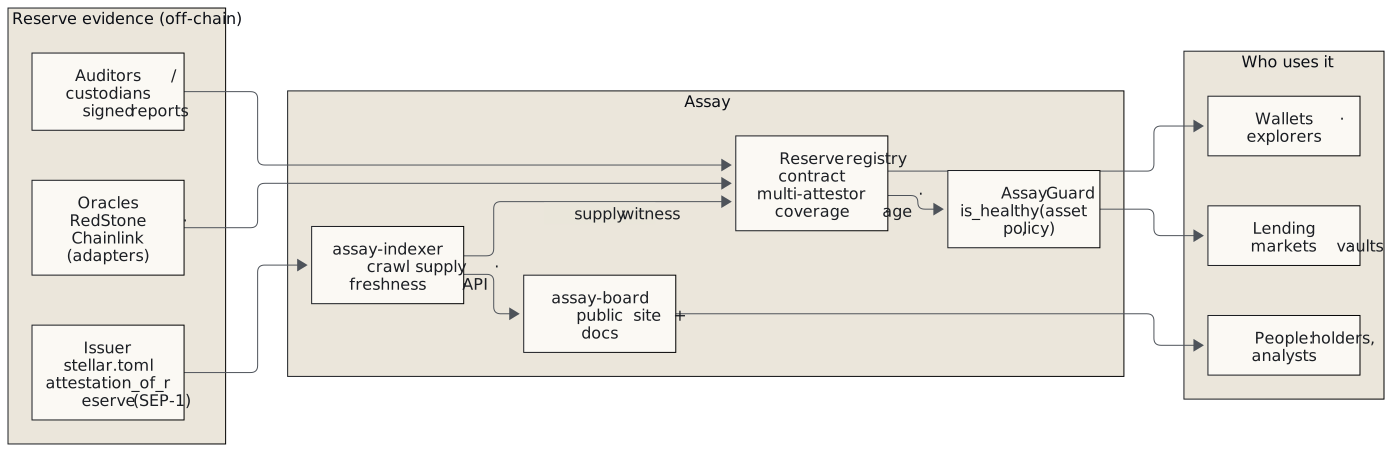
This is the target design. Today the indexer, board, registry and guard exist (the last two on testnet). Oracle adapters, the wallet and explorer integrations, and an indexer acting as supply witness are planned; see the roadmap.
See the flow map for each step, and the architecture for the full design.